The Effects of Natal Kicks in the Galactic Center
Status: Under Construction
At the center of nearly every galaxy, there exists a supermassive black hole (SMBHs) with masses between millions and billions of solar mass. Surrounding these SMBHs is an incredibly dense region filled with stars and stellar remants known as the nuclear star cluster. Our own Galactic Center hosts a SMBH, called Sgr A*, with a mass of $4 \cdot 10^6 M_\odot$.
Observational studies of the Galactic Center have revealed the existence of numerous massive, young stars within the central 0.5 pc (some of which are shown in Figure 1). It has been established that massive stars in the Galaxy tend to reside in binary or higher order configurations and a combination of osbervational and theoretical arguments suggest that this may also be the case for the massive, young stars in the vicinity of the SMBH.
The evolution of massive star binary systems is drastically different that low-mass binary star systems because massive stars die in violent, supernovae explosions that leave behind either a neutron star or stellar mass black hole. The supernovae explosion is not expected to be slightly asymmetric, resulting in a velocity kick given to the compact object at birth.
These natal kicks range from a few 10s of km/s up to a few 100 of km/s and have the potential to drastically alter the orbital parameters and even the orbital configuration of the binary around the SMBH. An important question we seek to explore is: How do natal kicks affect the final compact object distribution around the SMBH, given an initial stellar distribution of binaries?
The initial stellar distribution for stars in the Galactic center around Sgr A* can be modeled as a power-law: $\rho \sim r^{-\alpha}$ where $r$ is the radius from Sgr A* and $\alpha$ is a parameter that sets the steepeness of the distibution. Larger values of $\alpha$ indicate steeper distributions where many stars are located in close proximity around Sgr A* and smaller values of $\alpha$ indicate shaller distributions with less stars in the central regions of Sgr A*. For reference, many of the stellar populations in the GC follow a power-law distribution with values of $\alpha$ between 1 and 2.
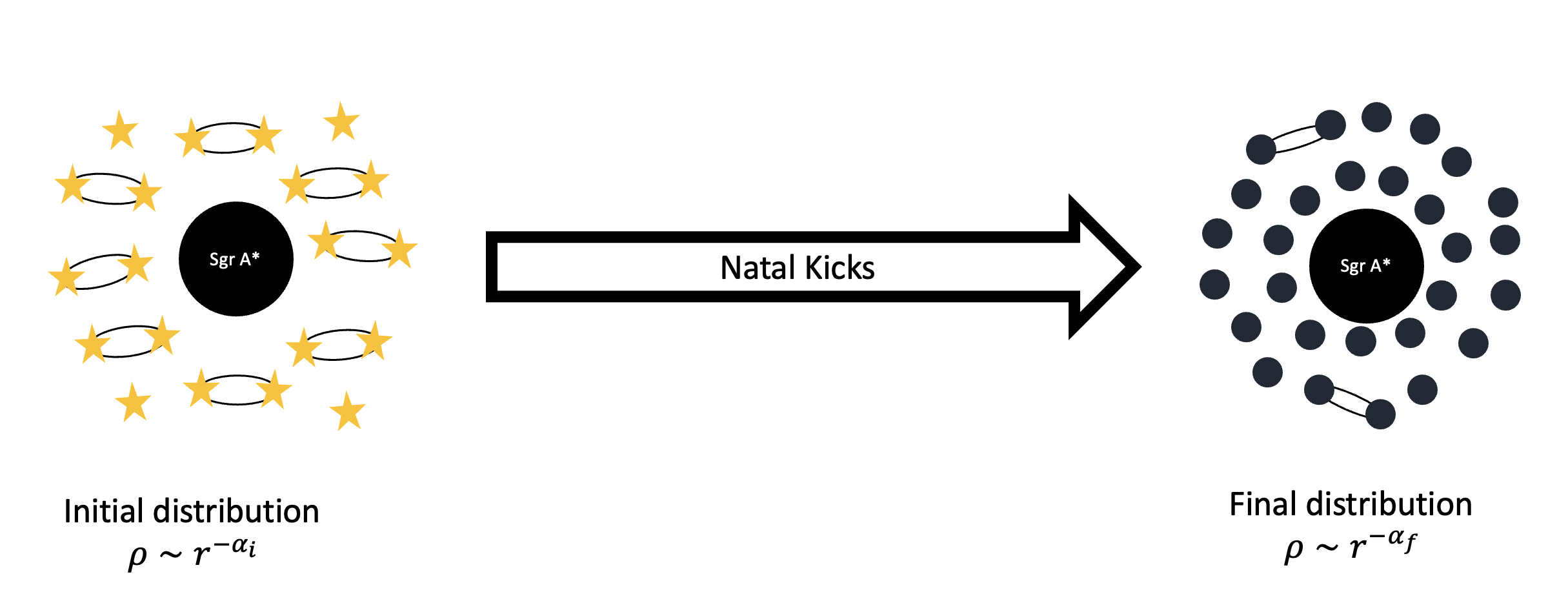
Figure: Initially most of the stars are in binary configurations with another star and orbit Sgr A* together. As the most massive stars go supernovae, the natal kicks can drastically alter the configurations, unbinding many of the binaries and even changing the compact object's distribution around Sgr A*.
Publication:
Jurado, C.; Naoz, S.; Lam, C. Y.; Hoang, B-M.,
“Natal Kicks from the Galactic Center and Implications on Their Environment and for the Nancy Grace Roman Space Telescope,” ApJ.
https://doi.org/10.3847/1538-4357/ad55ee